Large paraoesophageal hernia repair
How part of the stomach can slide up beside the food pipe into the chest, and how keyhole surgery returns it and repairs the diaphragm.
- Length
- 02:59
- Specialty
- Upper GI
- Style
- Anatomy only
- Includes
- Subtitles and transcript
Transcript · 484 words
What the film says
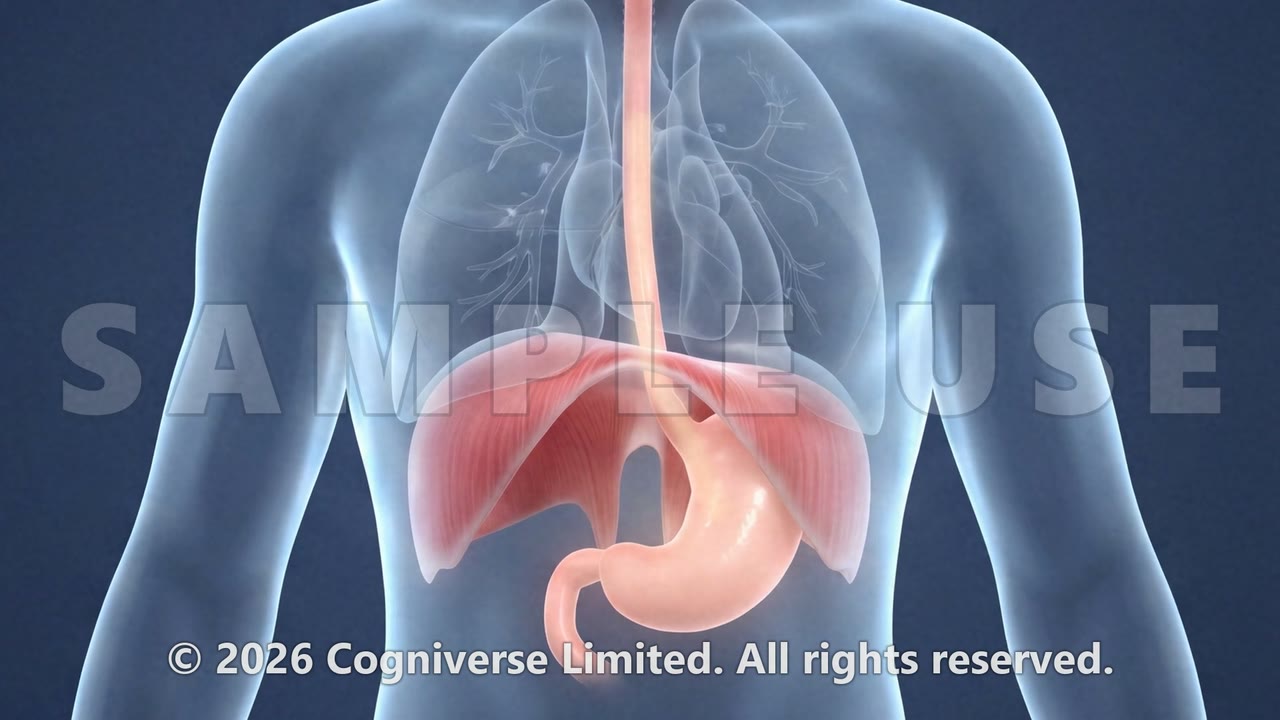
A hiatus hernia is when part of your stomach pushes up into your chest; most are small. This film is about a large one, and the operation to repair it. Normally, your food pipe passes through a small opening in the diaphragm, the sheet of muscle beneath your lungs.
The food pipe then joins your stomach, just below the diaphragm. In the common, sliding type, that join simply slides up through the opening. In a para-oesophageal, or rolling, hernia, the opening has widened, and part of the stomach rolls up beside the food pipe, into the chest.
In a large hernia, half the stomach or more can sit in the chest. Sometimes other organs, such as the bowel, move up too. Some people have few symptoms, or none.
Others feel pain in the chest or upper tummy after eating, feel full quickly, or become breathless after meals. Swallowing can be difficult, food can come back up, and slow bleeding from the stomach lining can cause anaemia, leaving you tired. Rarely, the stomach can twist, or become trapped in the chest.
That is an emergency. If you have sudden, severe pain in your chest or upper tummy, keep retching or being sick, or can't swallow, call 999 or go to A&E. To plan treatment, your team will usually arrange a camera test and a CT scan, and sometimes a swallow X-ray, or tests of how your food pipe works.
Surgery is usually offered when a large hernia is causing symptoms. Your surgeon will weigh this with you against your age and general health. The repair is usually done by keyhole surgery, under general anaesthetic, through a few small cuts in the tummy wall.
First, the stomach is gently drawn back down, out of the chest and into the tummy. The hernia sac, the lining that stretched up into the chest with it, is freed and removed. The food pipe is freed too, so that a length of it lies comfortably below the diaphragm, without tension.
Then the widened opening is narrowed with stitches. Sometimes a mesh is used to reinforce it. Finally, the top of the stomach is usually wrapped around the lower food pipe and stitched, to help hold everything below the diaphragm, and to help reduce reflux.
Most people stay in hospital for one or two nights, and are up and walking soon after. You start on fluids, then soft, moist food in small meals, building back to normal over about six weeks. Swallowing can feel tight at first, and you may feel bloated.
This usually settles over the following weeks. Avoid heavy lifting for several weeks, while the repair heals. For most people, symptoms improve a great deal.
A large hernia can come back over time, often without causing symptoms, and a few people need another operation. If a hiatus hernia is affecting your eating or your breathing, talk to your GP.
This film is general patient education. It is not medical advice and does not replace a consultation with your own doctor. In an emergency call 999. People shown in the film are AI-generated.