Anti-reflux surgery: repairing the valve
Why acid reflux happens, who is offered surgery, and how a fundoplication rebuilds the valve between the food pipe and the stomach.
- Length
- 03:07
- Specialty
- Upper GI
- Style
- People and anatomy
- Includes
- Subtitles and transcript
Transcript · 529 words
What the film says
Acid reflux is common. For most people, a few changes and some medication are enough. But for some, the burning comes back as soon as the tablets stop.
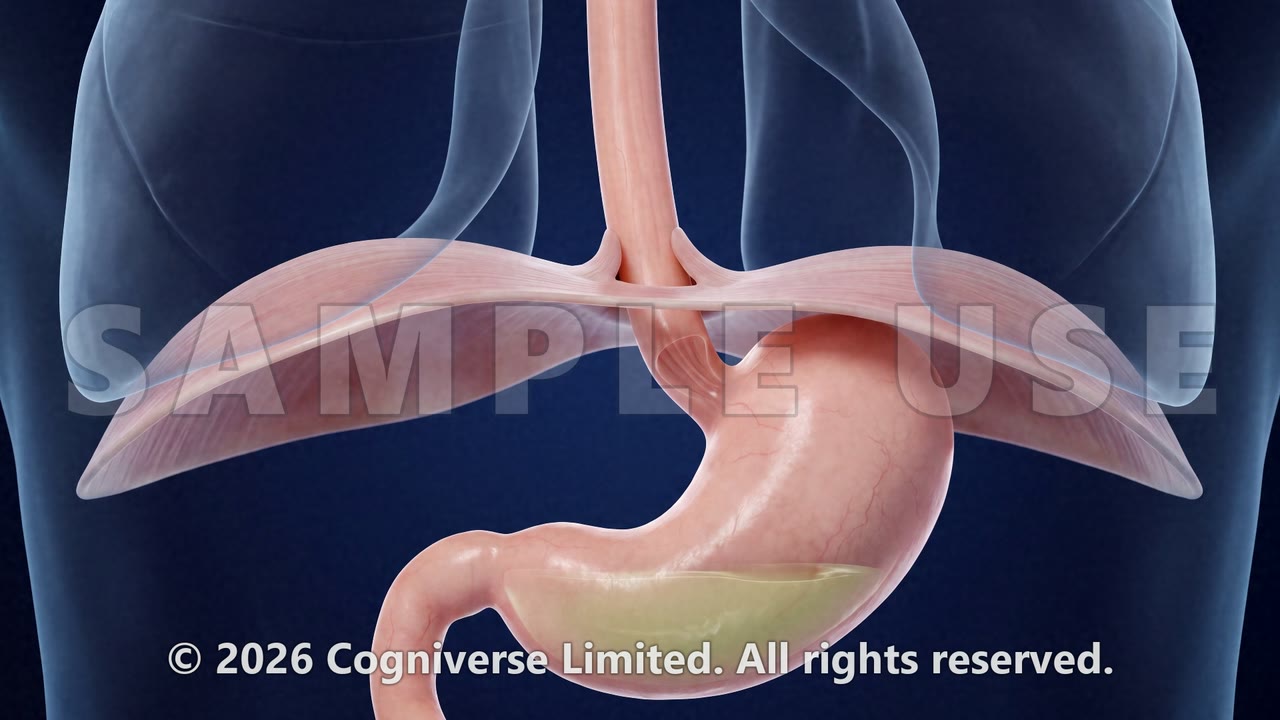
Where your food pipe meets your stomach, a ring of muscle works as a one-way valve. It opens to let food through, then closes again to keep stomach acid where it belongs. The diaphragm, the sheet of muscle beneath your lungs, wraps around that join and helps hold it shut.
In reflux disease, the valve no longer closes properly, and acid washes back up into the food pipe. Sometimes part of the stomach has slipped upwards through the diaphragm. That's a hiatus hernia, and it pulls the valve out of position.
The lining of the food pipe isn't built for acid, so it becomes sore and inflamed. That is the burning you feel. Acid-reducing tablets turn the acid down, and for most people that's enough.
But they don't repair the valve itself. If your symptoms aren't settling, or you're thinking about surgery, your GP can refer you to a specialist. Surgery is considered when reflux has been confirmed by testing and tablets control it, but you'd rather not take them for life, or you can't tolerate them.
So testing comes first. A camera passed through the mouth looks at the lining of the food pipe and stomach. A pH study measures how much acid comes back over twenty-four hours, and whether that matches your symptoms.
And manometry measures the squeeze of your food pipe, to check it works well enough for the operation. The operation is called a fundoplication. It's done under general anaesthetic, through a few small cuts rather than one large one.
The surgeon frees the lower food pipe and the top of the stomach, so they can move without tension. If the gap in the diaphragm has widened, the stomach is drawn back down below it, and the gap is stitched back to size. Then the top of the stomach is wrapped around the lower food pipe and held with stitches, rebuilding the valve from your own tissue.
In a Nissen repair, the wrap goes all the way around: three hundred and sixty degrees. In a Toupet, it goes about two hundred and seventy degrees, around the back, leaving the front of the food pipe open. In an anterior, or Watson, repair, it goes about a hundred and eighty degrees, across the front, leaving the back of the food pipe open.
Your surgeon chooses between them to suit your anatomy and your test results. Most people stay one or two nights, and are up and walking the same day. You start on fluids, move on to soft food, and build back to normal texture over about six weeks.
Swallowing often feels tight at first, and usually settles. Burping can be harder, and you may feel bloated, more so after a full wrap than a partial one. Most people get lasting relief, and many are able to stop their tablets.
Some need them again over time, and a small number need a further operation. If reflux is still running your day, talk to your GP about a specialist referral.
This film is general patient education. It is not medical advice and does not replace a consultation with your own doctor. In an emergency call 999. People shown in the film are AI-generated.