Inguinal hernia: symptoms and robotic repair
What a groin hernia is, when it becomes an emergency, and how a robotic keyhole repair places mesh behind the muscle wall.
- Length
- 02:54
- Specialty
- Hernia
- Style
- People and anatomy
- Includes
- Subtitles and transcript
Transcript · 471 words
What the film says
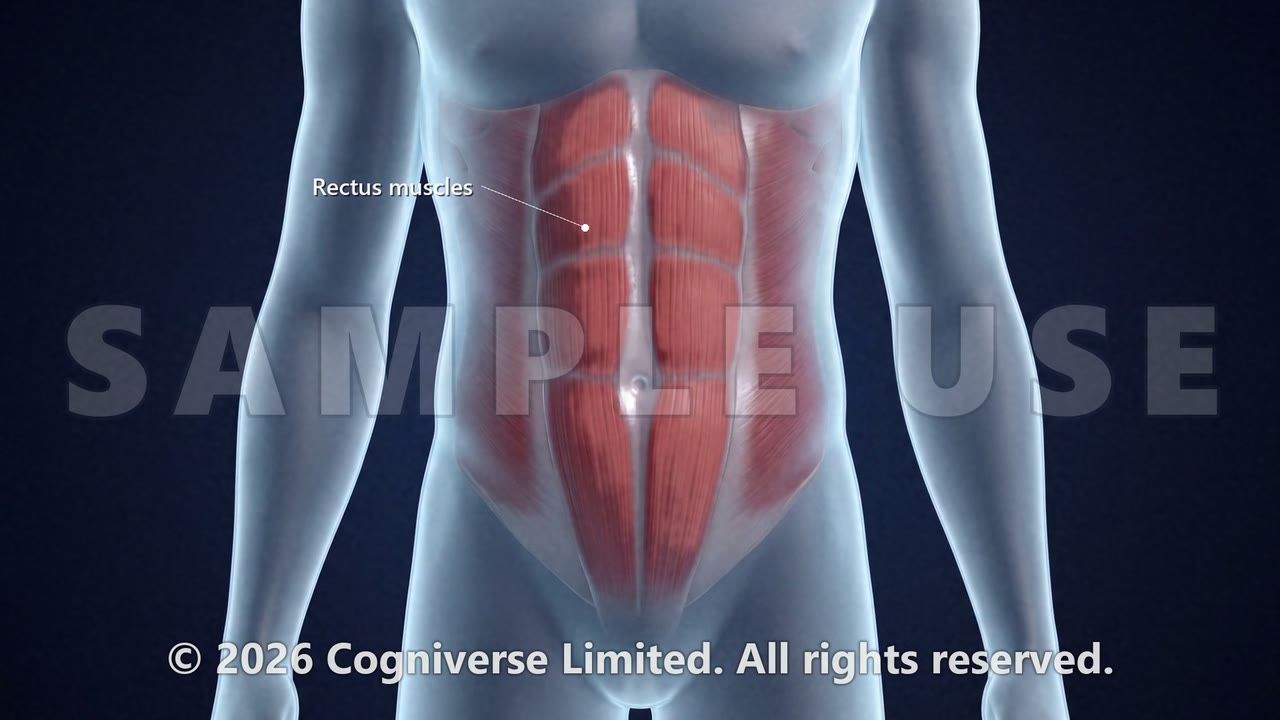
A hernia is a lump that forms when fatty tissue, or part of the bowel, pushes through a weak spot in the muscle wall that normally holds it in. Hernias can develop in different places: near the belly button, in the upper thigh, through the scar of a previous operation, or in the chest. The most common type is an inguinal hernia, in the groin, where the top of the leg meets the tummy.
It's much more common in men. In the groin, there's a natural passage through the muscle wall, called the inguinal canal. In men, it carries the cord that runs to the testicle.
Some people are born with a weakness here. In others, the muscle wall weakens over time. Anything that increases pressure inside the tummy can push tissue through, such as heavy lifting, a long-lasting cough, or straining.
The main sign is a lump or swelling in the groin. It may get bigger when you stand or cough, and disappear when you lie down. It can ache or feel heavy, especially when you lift or bend, and in men, the lump can extend into the scrotum.
Not everyone has symptoms. If you notice a lump in your groin, see your GP. A doctor can usually tell if it's a hernia by examining you, sometimes while you stand and cough.
Occasionally, a scan is needed. Rarely, part of the bowel becomes trapped, and its blood supply can be cut off. This is an emergency.
Call 999 or go to A&E if the lump becomes suddenly very painful, hard, or can't be pushed back, or if you're being sick, or can't poo or pass wind. If a hernia is causing symptoms, an operation to repair it is usually recommended. Your surgeon will talk you through the options.
Many repairs are done with keyhole surgery, and some hospitals use a surgical robot. It's usually a day case, under general anaesthetic. A few small cuts are made in the tummy.
The surgeon sits at a console in the operating theatre and controls the robot's instruments. Inside, the lining of the tummy is opened over the groin, and the hernia is gently pulled back into place. A sheet of mesh is laid over the weak area, covering the places where a groin hernia can form.
The lining is then closed over the mesh with stitches. Over time, the body's own tissue grows into the mesh and strengthens the wall. Most people go home the same day.
You'll need to avoid heavy lifting and strenuous activity for at least four to six weeks. Recovery usually takes up to six weeks. Many people are back at work within one to two weeks, and your care team will tell you when you can drive.
If you notice a lump in your groin, see your GP.
This film is general patient education. It is not medical advice and does not replace a consultation with your own doctor. In an emergency call 999. People shown in the film are AI-generated.